
by Frans Stiene
“A star, a defective view, the butter lamp flame, an illusion, a dew drop, or a water bubble, a dream, lightning, a cloud — see all causative phenomena like this.” – Buddha
Within Okuden Reiki II we have 3 specific symbols, and in this blog I would like to explore the first symbol.
Traditionally the first symbol is linked to the kanji kami 神. Kami stands for divine being. Of course within the system of Reiki, it points to our own inner divine being, not something external, some “other” divine being.
When I was training for 5 days on Mt Omine in Japan, I noticed a symbol which looked very similar to the first symbol in Okuden Reiki II. I asked the head priest, Kyosei Yamauchi Sensei, if I could ask him some questions. I drew the first symbol on a piece of paper and as soon as I had finished he said, “This means; go to kami – go to your essence.” “Go to your essence.” This of course means, “Remember your true self, your inner divine being. And he explained that it came from the kanji kami.
“All humans have the potential to become Kami.” – The Essence of Shinto Japan’s Spiritual Heart by Motohisa Yamakage
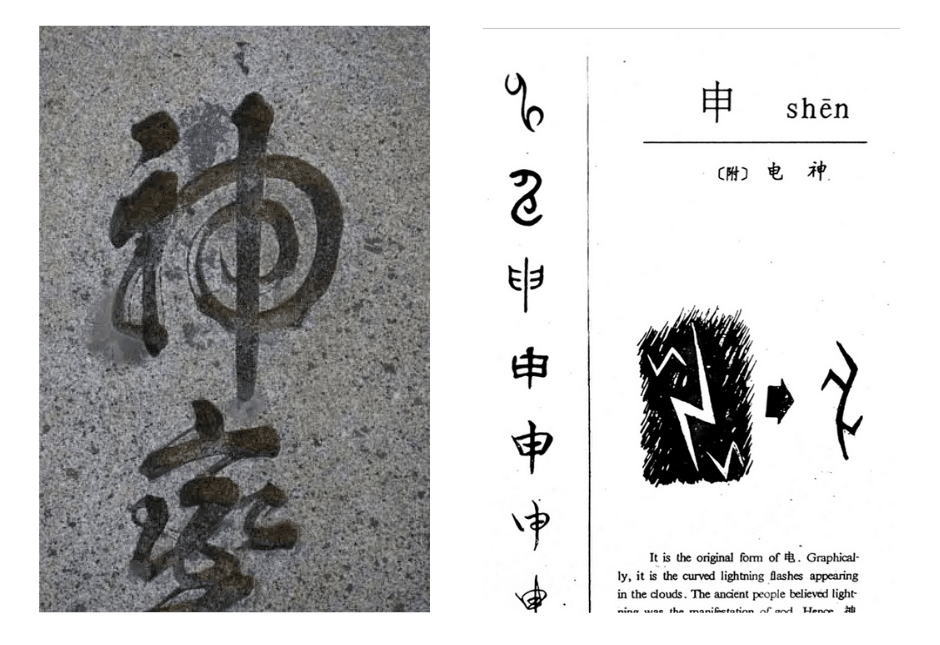
Here are two images; the first one is the kanji of kami which I saw on Mt Omine, and the second one is from the book Tracing the Roots of Chinese Characters: 500 Cases by Li Leyi, explaining the etymology – historical background of the kanji kami.
In the historical background image we can see different ways in which the kanji was drawn, and that it is linked to lightning appearing in the clouds
In some Japanese traditions this symbol has a name attached: Zuiun or Kumo. Zuiun means auspicious cloud and Kumo means cloud. This of course makes perfect sense, as lighting emerges from clouds and in the old teachings these lightning clouds were seen as auspicious. So as we can see, Zuiun and the symbol are interlinked with each other.
“If you want to appreciate something fully, you should forget yourself. You should accept it like lightning flashing in the utter darkness of the sky.” – Zen Mind, Beginner’s Mind by Shunry Suzuki
This forgetting ourselves and accepting it like lightning flashing – without judgement, it is as it is – is another central element within the system of Reiki.
“Its essence is seeking the harmony of body and mind. When engaged in self-cultivation by doing seiza, forgetting the “self” is of utmost importance. When it comes to self-cultivation, one must discard all thoughts” – Reiki and the Benevolent Art of Healing by Tomita Kaji, published in 1933
In other traditions we have the name Choku rei attached to this symbol, which also makes perfect sense as Choku rei translates as divine spirit, which is nothing other than our own divine being.
“There I encountered my own divine spirit [Choku Rei 直霊] ” – From Masahisa Goi’s book, “Living Like the Blue Sky – 5 talks by Masahisa Goi
The style of calligraphy of the first symbol is bokuseki, a style of calligraphy created by Zen monks and nuns which expresses their state of mind. Therefore Mikao Usui was expressing his own state of mind, the state of mind of Kami.
Of course Mikao Usui stated in an interview that the state of mind of Kami is the principal object of his teachings.
“Q. Does Usui Reiki Ryoho only heal illness?
A. No. Usui Reiki Ryoho does not only heal illness. Mental illnesses such as agony, weakness, timidity, irresolution, nervousness and other bad habits can be corrected. Then you are able to lead a happy life and heal others with the mind of Kami or Hotoke [Buddha]. That becomes the principal object.” – Interview with Mikao Usui in Shin-Shin Kaizen Usui Reiki Ryoho Kokai Denju Setsumei and the Usui Reiki Ryoho Hikkei, two booklets handed out by the Usui Reiki Ryoho Gakkai
To put it all in a nutshell, Mikao Usui put the first symbol and name/mantra in Okuden Reiki II (okuden translates as hidden teachings or inner teachings) to help us remember that we are Kami, a divine being, or in other words that we are Reiki, the great bright light. This is the hidden inner teachings, hidden deep inside of our own mind.
“A student of the famous Zen master Hakuin Ekaku was working on the koan “Who is it that does this work?” Meanwhile she feared thunderstorms. One night she sat through a violent storm in order to confront that fear as part of her meditation. When a bolt of lightning struck near her, she lost consciousness — and upon waking, her perception had completely shifted. Her teacher recognized this as a moment of Zen awakening.” – Roshi Linda Myoki Ryugo Lehrhaupt
And so how do we describe a person who has awakened to the knowledge, who has rediscovered that their essence is kami, divine? This is a person who has no anger and worry, who is grateful, true to their way and their being and who has a compassion which does not change according to circumstances. And this embodiment, in all we do today, is the principal object of Mikao Usui’s teachings.
This does not mean that we should expect to awaken or rediscover our divine being like a lightning bolt. Rather, without expectations or judgements we continue our practice, we just practice. In this just practicing without expectations we start to realize that we are already and have always been divine.
Comments 2
Reading First Reiki Symbol on ihreiki.com reminded me that healing is not just a technique but a quiet dialogue between intention and presence, because beneath every ancient symbol lies an invitation to open more fully to the unseen currents that connect us to ourselves and to something greater than thought alone. This piece brings simplicity and depth together, honoring the lineage of Reiki not as mystique but as a living practice that asks for awareness, compassion, and a willingness to meet what is with honesty and grace. What resonates most is the way it honors both the humble beginnings of one’s healing journey and the profound truth that energy moves where attention goes, inviting us to approach ourselves with respect, curiosity, and the courage to lean into greater wholeness with each breath and each mindful intention.
Hi Kenneth,
Glad you like the blog.
Have a fabulous weekend
Love
Frans